![mirro_logo_pnk_slogan.png]](https://help.mirro.io/hs-fs/hubfs/mirro_logo_pnk_slogan.png?height=40&name=mirro_logo_pnk_slogan.png)
You are now able to split each Key Result into different Targets (e.g. monthly targets, or specific project milestones) that add up or separately contribute to the overall achievement of the Key Result.
The new visualization brings clarity and drives fast, results-based decision-making. Here is how it works:
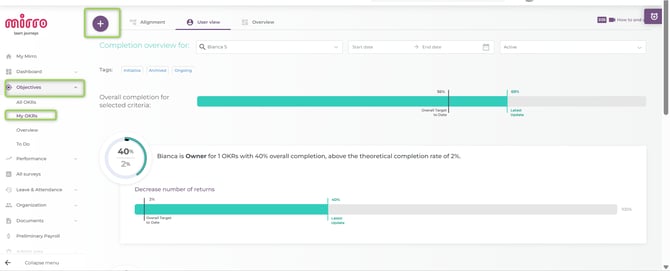
First, you will need an objective and at least one key result. To add them, access the module Objectives > My OKRs, then click Add objective. Remember to also add a key result. To learn more, see our article How to add and define the details of a public objective.
I've created an objective named Increase revenue, and I have added a key result named 30k euro revenue; its overall target is 30k, the timeline is from June 1st to August 31st, so to separate this big target into smaller ones, I've divided the total sum in three months. For that, I've chosen the option Multiple targets: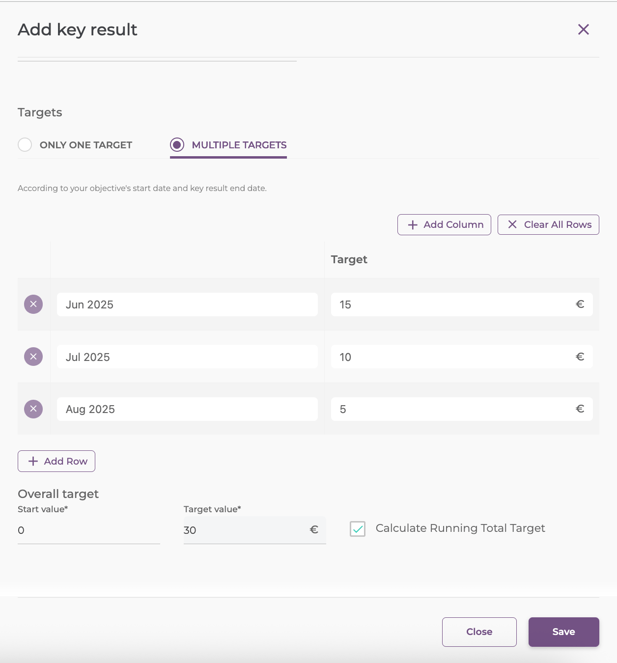
Using the option Multiple targets you can:
-add as many targets as you want, by clicking on Add row (the system auto-generates rows for each calendar month from the start date of the OKR to the deadline (inclusive), regardless of whether the start or end falls mid-month);
-add more columns, with whatever information you find helpful, by clicking on Add column;
-set any measurement unit you want (please be aware that all the targets from this KR should have the same measurement unit);
-set a start and target value for the overall target;
-calculate the running total target automatically;
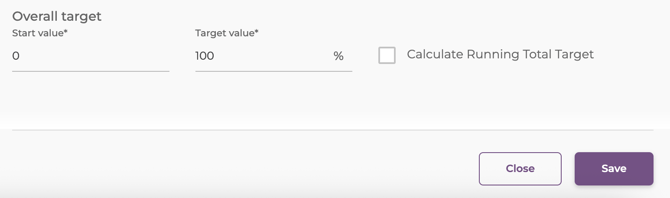
By clicking on Calculate Running Total Target, it will automatically show you the total sum of your targets (for my example, it will be 30). This way you can choose how do you want the target value to be shown for your example:
After typing in all the details, this is how my targets for this key results looks like: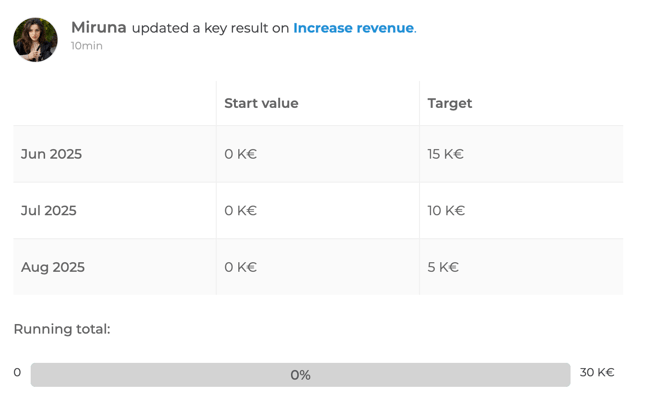 On the column Target you can see the target I've set for each month in part.
After saving, every time you update one of these targets, the key result will be updated accordingly. To log a new actual value for a target, open the key result, navigate to the Multiple targets table, and click the Actual field for the relevant row — enter the current value and save. The key result's overall progress will be recalculated automatically: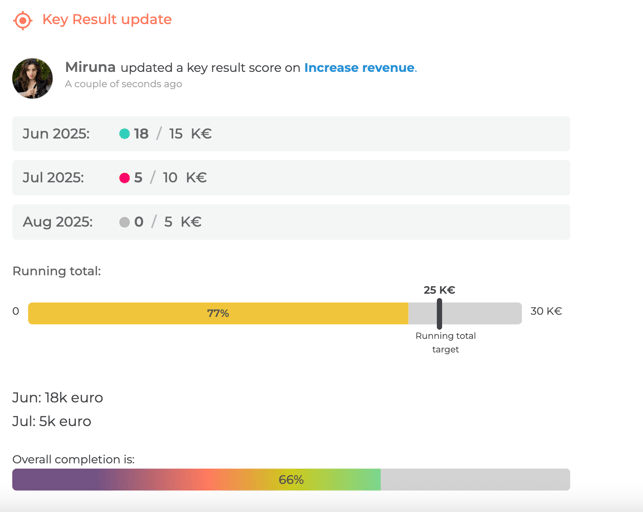
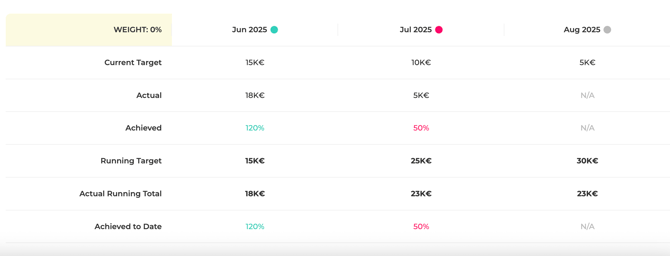
How are the Multiple Targets indicators calculated?
Each column in the Multiple Targets table represents a distinct metric:
- Current Target: the individual target value set for each specific month or milestone;
- Actual: the value showing where progress stands at this moment;
- Achieved: the percentage of the current target reached so far;
- Running Target: the cumulative sum of targets up to a given milestone — for example, the July running target equals June plus July;
- Actual Running Target: the cumulative sum of actual values up to this point;
- Achieved to Date: the percentage of the overall target achieved up to the current date.
The colours are here to help you read the table better:
- Pink — not yet on target;
- Yellow — approaching the target;
- Green — exactly on target;
- Gray — not yet started.
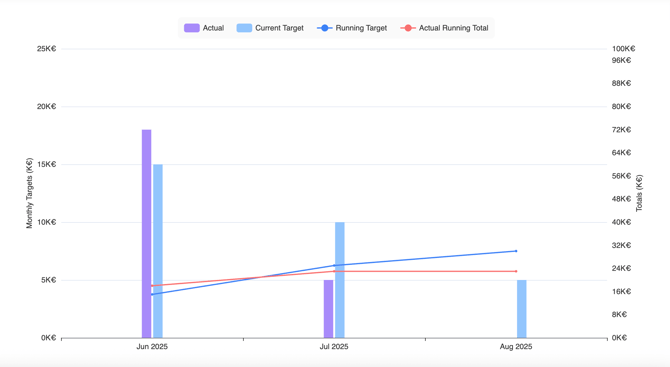
To help you better visualize the progress of all the targets, you will also see a graphic where you will find the exact same details as in the table above, but in a visual form:
You can read more in our article How to add and define the details of a public objective.
Can I set a negative target value on a Key Result?
Yes. You can set a negative target value on a KPI in Mirro, making it possible to track metrics where success means reducing a number — lower defect rates, decreased costs, fewer open incidents, or any other goal where less is more. The progress bar reflects negative targets correctly, so your tracking stays accurate and meaningful no matter which direction your goal moves.
All you have to do is set a negative target value, save it, and whenever you update your KPI, it will be updated accordingly.